Resurrection Day
Awakening the Angel System: Apocalypse: A LitRPG Progression FantasyResurrection Day is the decisive postwar turning point in which Jack's activation of the Infinity Machine's kill switch ends the magical order and unexpectedly restores thousands of people to life. It does not resemble a clean miracle: the survivors emerge amid wreckage, lost identities, disabled technology, and the collapse of Heaven, forcing the characters to confront both the cost of the old world and the responsibilities of the new one.
The World Before the Resurrection
The event follows a history of escalating violence. Political power had already been secured through mass killing: Selfia admitted that a purge was taking place across the empire and that 369 lives, possibly more, were being extinguished because they were opponents, rivals, or dissidents who might obstruct the New Republic. Jack rejected the language of necessity, emphasizing that hundreds had died, including bystanders and innocents, and that Selfia's actions had placed Ada's pregnancy and his child in danger. The event therefore arrives after a political order has repeatedly treated human beings as expendable material.
The military crisis was equally severe. Jack had ordered the remaining Theocracy population evacuated to the Flying City or transferred into Imperial territory because they lacked adequate food, shelter, and ammunition and faced the approach of the demonspawn. He and Selfia also considered attacking every suspected High Table position rather than allowing an enemy diversion to dictate their response. These decisions establish the world in which Resurrection Day occurs: survival is pursued through emergency commands, preemptive violence, and choices that continually turn protection into another form of danger.
The Collapse of the Old Order
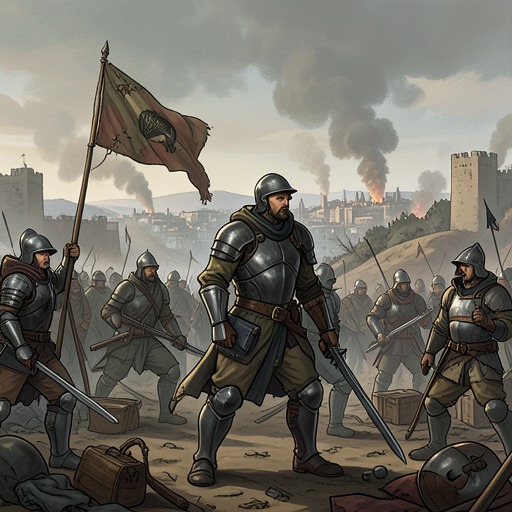
The immediate setting is a landscape already marked by devastation. On the shores of a new continent, Ada encountered corpses, flesh, and sinew spread across sand stained red by the invasion; poisoned water lapped at her boots while Imperial soldiers and Paladins scavenged masks and equipment from the dead. During the same campaign, the earth violently ruptured as miasma and mana swirled, revealing Heaven, a structure so immense that Sahaqiel recognized that the expedition had arrived too late. The supernatural fortress rose from blood-soaked ground as though the buried history of the war itself were breaking back into the present.
The event's wider stakes become explicit when Michael reveals that Adam, the first Awakened and the first hunter, has been preserved as a weapon against powerful beings. Sahaqiel protests that freeing Adam would kill the angels, doom the world, and betray all their sacrifices, but Michael insists that he is repairing the world rather than destroying it. Resurrection Day thus follows a final struggle over competing definitions of salvation: one side seeks to preserve humanity through control and sacrifice, while another must end the machinery that makes such salvation possible.
The Kill Switch and the Returned
After the kill switch is activated, the consequences are physical and immediate. Selfia's floating limbs fall onto a sandy beach, and she can no longer feel her mana. Ada discovers that her nodachi will not move and that her own strength has vanished. The flying city crashes into the sea, while the landscape is stripped of the corruptive purple smog. Magic is not merely weakened as a battlefield resource; it disappears from ordinary experience, leaving formerly empowered people suddenly dependent on bodies, tools, and institutions that no longer function as before.
The cleared horizon reveals thousands of confused men and women wearing outdated uniforms and armor. Their clothing makes the restoration inseparable from history: the returned are not simply anonymous dead, but people brought back from earlier conflicts and eras, carrying the material traces of worlds that the living had already considered finished. Selfia recognizes Eleanor, a white-haired officer, and witnesses Eleanor reunite tearfully with a blonde, red-eyed woman in a MECHFrame pilot's uniform. She then recognizes Ruby, alive and full of color, standing beside officers and Python. The reunion turns the event from an abstract global reversal into a sequence of intimate recognitions, each face forcing the present to admit that its dead have not remained safely in the past.
The emotional uncertainty is concentrated in Ada's question about Tanji. Ruby lowers her head, takes Ada's hands, and speaks to her for the first time as a living person. The evidence leaves the precise answer to that exchange outside the event's immediate revelation, but the gesture establishes the central condition of Resurrection Day: return does not erase grief, confusion, or absence. It creates a new burden of explanation, identification, and mourning among people who have been restored into a world that has moved on without them.
Aftermath and Reconstruction
Five years later, the consequences have become visible in a transformed civic landscape. Jacksonville, called the Bastion of the New Frontier, stands on unexplored land where Lita and the Hoshido have established a sovereign country. A shoreline once associated with invasion and death has become a sunny public space, with families and children on the beach, tourists along the coast, and fishermen using the piers. The contrast between poisoned water and gentle waves, between corpses on foreign sand and ordinary recreation, gives the resurrection its most concrete measure: livability has returned, but only through time and collective labor.
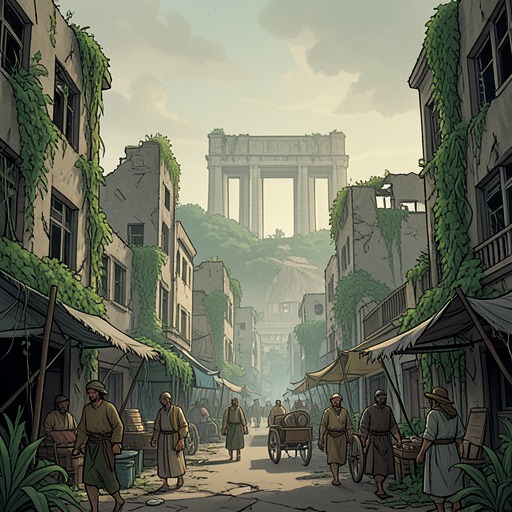
Heaven undergoes an equally striking conversion. What remains of the former demonspawn stronghold becomes the capital of the Frontier's government and a forward base for explorers seeking lost treasures. Gold walls and marble pillars remain, but wires, electric signs, homes, shops, and silver-wing banners for the twelve-member Frontier council alter their meaning. The ruins no longer function as an untouchable fortress of supernatural power; they become administrative and commercial space within a society trying to organize the thousands of newly resurrected and give them homes.
That reconstruction is difficult rather than triumphant. Selfia anticipates a tremendous amount of paperwork while her detached limbs lie in the sand, and her attempt to call Mi'shka receives no response. The practical detail matters because it places bureaucratic work beside cosmic catastrophe. Once mana, flying cities, and resurrection systems cease to govern existence, survival depends on installation, housing, transportation, councils, delegations, and the slow conversion of ruins into places where people can live.
Narrative Significance
Resurrection Day reverses the book's governing economy of death. The purge, the bloodbath on the new continent, the battlefields shattered by weapons and supernatural movement, and Michael's plan to awaken Adam all treat death as an instrument for constructing a promised future. The kill switch interrupts that logic. It ends the magical system, but it also releases people from the closed cycle in which institutions decide who may be sacrificed, preserved, or restored.
The event remains morally unsettled because restoration cannot return the lost world exactly as it was. The resurrected arrive in obsolete uniforms among strangers; survivors lose their mana and weapons; Heaven falls into the sea; and the former fortress is later rebuilt as a government capital. Resurrection therefore signifies neither a simple return nor a restoration of origins. It is a rupture in historical continuity, after which recognition, grief, political compromise, and environmental repair must do the work once assigned to magic. The final image of a populated beach and a civilized Heaven gives the event its lasting significance: humanity survives not by recovering the old order, but by making a habitable future from its ruins.